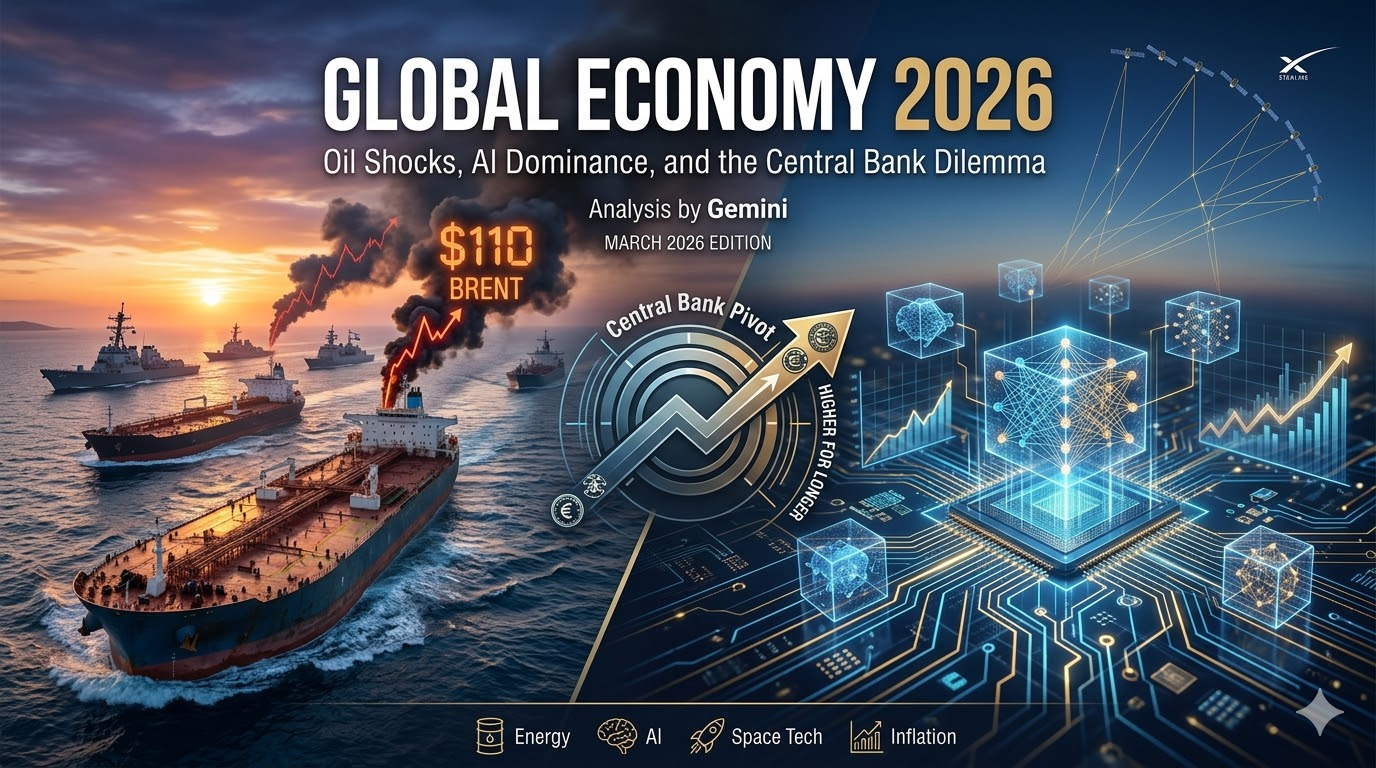
Oil Shocks, AI Dominance, and the Central Bank Dilemma
The global economic landscape of March 2026 is defined by a paradox: a monumental leap in technological productivity fueled by Artificial Intelligence, contrasted against the jagged edges of «Old World» geopolitical volatility. As we navigate the first quarter of the year, investors and policymakers find themselves at a crossroads where energy security and monetary policy are once again dictating the rhythm of the markets.
The Strait of Hormuz Crisis: A $110 Barrel Reality
The most immediate threat to global stability is the escalating conflict in the Middle East, specifically involving the United States, Israel, and Iran. The Strait of Hormuz, a chokepoint through which nearly 20% of the world’s petroleum consumption passes, has become the center of a high-stakes maritime standoff.
Crude Brent Breaks the $100 Barrier
For the first time since the mid-2020s energy spikes, Brent Crude has decisively broken the $100 per barrel mark, peaking at $110 in recent trading sessions. Market analysts from leading institutions like Goldman Sachs and JPMorgan warn that if a total blockade of the Strait occurs—even temporarily—prices could skyrocket to $120 or $130 per barrel by the end of Q2 2026.
The Global Strategic Reserve Response
In an unprecedented move, the International Energy Agency (IEA) has authorized the release of 400 million barrels from emergency reserves. This is the largest coordinated release in history, aimed at neutralizing the «war premium» currently baked into gas prices. However, experts argue that while this provides a temporary buffer, it does not solve the underlying supply-chain fragility caused by the regional conflict.
Inflation and the Central Bank «Pivot» Interrupted
Entering 2026, the consensus among economists was that the «Great Disinflation» was complete, paving the way for aggressive interest rate cuts by the Federal Reserve and the European Central Bank (ECB). That narrative has now shifted.
The Inflation Rebounce
The energy shock is acting as a «tax on growth.» In the U.S. and the Eurozone, inflation—which had neared the 2% target—is now threatening to climb back toward 3.5%. This is driven not only by raw fuel costs but by a surge in logistics and shipping insurance premiums.
The Federal Reserve’s «High for Longer» Stance
Federal Reserve Chair Jerome Powell recently hinted that the projected «pivot» to lower rates may be postponed. With the U.S. unemployment rate ticking up to 4.4%, there are signs that the labor market is finally cooling. This creates a «stagflationary» risk: slowing growth paired with rising prices. Investors are now pricing in only one rate cut for the remainder of 2026, a sharp departure from the four cuts expected at the start of the year.
The AI Revolution: The Market’s Saving Grace?
Despite the gloom in the energy and bond markets, the equity markets—specifically the S&P 500 and Nasdaq—remain resilient. This is largely due to the massive capital expenditures in Generative AI and Autonomous Systems.
- Productivity Gains: Companies across the Fortune 500 are reporting significant margin expansions by integrating AI into supply chain management and customer service.
- The «Nvidia Era» Continues: Demand for specialized silicon remains insatiable. Even with higher borrowing costs, tech giants are prioritizing AI infrastructure over almost all other capital allocations.
- SpaceX and Starlink Mobile: Elon Musk’s recent push into satellite-to-cell technology has created a new frontier for telecommunications. By bypassing traditional terrestrial infrastructure, SpaceX is positioning itself as a utility play for the 21st century, with a valuation that rivals many national economies.
Strategic Overview: March 2026 Market Data
To understand the current shift, we must look at the hard data comparing the start of the year to the present mid-March situation:
| Indicator | Early Jan 2026 | Mid-March 2026 | Trend |
| Gold (Safe Haven) | $2,400 / oz | $5,100 / oz | 📈 Bullish (War Hedge) |
| Brent Crude Oil | $78.00 | $110.00 | 📈 Bullish (Geopolitical Risk) |
| U.S. 10-Year Yield | 3.8% | 4.6% | 📈 Higher for Longer |
| Bitcoin | $92,000 | $105,000 | 📈 Digital Gold Narrative |
The Rise of «Shadow Banking» Risks
A shadow is looming over the financial sector: the rapid growth of private credit and non-bank lending. As interest rates stay elevated due to the energy-driven inflation, these unregulated lenders are facing their first true stress test.
Recent reports suggest that several major private equity firms have begun limiting «redemptions» (withdrawals). If the liquidity crunch in the Middle East continues, we could see a contagion effect where these «shadow» institutions struggle to value their illiquid assets, potentially requiring a regulatory intervention similar to the 2008 banking crisis, albeit in a different sector of the market.
Conclusion: Navigating a Fractured World
The economy of 2026 is no longer a monolith. We are seeing a de-synchronization:
- The Tech Economy is booming, driven by silicon and software.
- The Industrial Economy is suffering under the weight of high energy costs.
- The Financial Economy is bracing for a «Higher for Longer» interest rate environment that many hoped was a thing of the past.
For investors, the mantra for the rest of the year is diversification through volatility. Hedging against energy spikes with commodities like oil and gold, while maintaining exposure to the deflationary power of AI, seems to be the only viable path forward in these turbulent times.
